Our goal is to create an engaging environment for every child. Play is one of the most important ways to nurture a child’s development. In the first five years of life, a child’s brain forms many neural connections essential for future learning. Sensory play stimulates their senses, improves curiosity, attention span, memory, brain development, and overall learning.
Developmental milestones, secure muscle coordination, self-image, and an understanding of how the world works are achieved through sensory, play-based learning. Through play, children learn problem-solving, communication, and interpersonal skills needed for success in school.
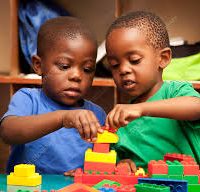
- Blocks – Toy blocks and other construction toys may not dazzle like battery-powered robots or video games, yet they are indispensable for childhood development. Developmental psychologist Rachel Keen stresses the significance of cultivating problem-solving skills from an early age through thoughtfully designed environments. Parents and teachers play a pivotal role in creating these environments, offering children opportunities to engage with toys that enhance spatial awareness, fine motor skills, and imaginative thinking. This approach not only prepares children for academic challenges but also fosters resilience and adaptability essential for lifelong learning and success.

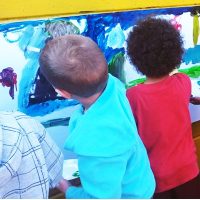
- Painting–Painting is more than just a creative outlet for children—it’s a valuable skill that fosters numerous developmental benefits. By engaging in painting, children not only express their creativity but also enhance their cognitive and motor skills. This artistic activity stimulates their imagination and allows them to explore colors, shapes, and textures in a hands-on manner.Learning to paint encourages children to experiment and problem-solve as they mix colors and manipulate brushes. It also promotes concentration and patience, as they learn to focus on completing their artwork. These skills are transferable to various aspects of life, including academic tasks and social interactions.Moreover, painting provides children with a sense of accomplishment and self-expression. It boosts their confidence as they see their ideas come to life on paper or canvas. This confidence can positively impact their overall development and willingness to tackle new challenges.In essence, painting not only allows children to have fun and express themselves but also nurtures essential skills that contribute to their holistic growth and future success.
- Play Dough –Play dough is a ubiquitous play material found in nearly every early learning environment, beloved for its ability to captivate young children and inspire hours of imaginative play. This versatile substance allows children to explore their creativity freely, shaping and molding it into various forms, from simple shapes to elaborate creations.Engaging with play dough offers numerous developmental benefits. It helps children develop fine motor skills as they knead, roll, and manipulate the dough, promoting hand-eye coordination and finger dexterity. The tactile experience of squishing and shaping the dough also stimulates sensory exploration, providing a satisfying and calming sensory experience for children.Moreover, play dough encourages cognitive development as children experiment with different textures, colors, and shapes. It fosters problem-solving skills as they figure out how to create specific forms or combine colors. Additionally, playing with play dough promotes social interaction and language development when children collaborate on projects or discuss their creations with peers.In early childhood settings, play dough is not just a playful pastime but a valuable educational tool that supports holistic development. It nurtures creativity, fine-tunes motor skills, and cultivates social-emotional skills, making it an essential component of early learning environments worldwide.

- Reading Corner –The Reading Corner is meticulously crafted to provide young learners with an optimal academic environment centered around quality literacy instruction. It serves as a cozy and inviting space where children can immerse themselves in books, storytelling, and language-rich activities. By integrating best practices in early childhood education, educators ensure that the activities and materials offered are tailored to each child’s developmental stage and learning needs.In this nurturing environment, children not only develop foundational literacy skills such as phonics, vocabulary, and comprehension but also cultivate a lifelong passion for reading. The Reading Corner encourages exploration and discovery through a variety of age-appropriate books and interactive learning experiences. By fostering a positive association with reading from an early age, it sets the stage for academic success and a love of learning throughout a child’s educational journey.

- Puzzles – From early childhood through adulthood, puzzles are beloved for their ability to challenge our thinking and exercise our minds. They are also crucial educational tools for toddlers and young children, offering skills like problem-solving, spatial awareness, and logical reasoning. Puzzles stimulate brain development, enhance fine motor skills, and promote social interaction through collaborative play. In educational settings, they integrate seamlessly into various subjects, making learning enjoyable while reinforcing academic concepts. Overall, puzzles play a vital role in fostering cognitive growth and preparing children for lifelong learning and success.

- Lego – In early childhood education, leveraging LEGO Education Preschool sets such as the Dolls Family Set offers a rich platform to promote comprehensive child development. Through interactive play and structured activities, these sets stimulate fine motor skills as children handle and assemble pieces, while also encouraging gross motor skills through larger-scale construction projects.Moreover, the sets foster self-help and adaptive skills as children learn to organize and utilize the pieces effectively. Language development flourishes as they engage in imaginative storytelling and dialogue during role-playing scenarios.Cognitive abilities are nurtured through activities that involve sorting, matching, and problem-solving with the blocks. Additionally, social-emotional skills are honed as children collaborate, negotiate roles, and navigate social interactions within group play.By integrating these versatile sets into the curriculum, educators create dynamic learning experiences that cater to diverse developmental needs, ensuring that each child can thrive and grow across multiple domains.
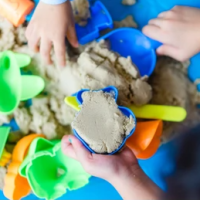
- Sand Play – Children are naturally drawn to the sensory-rich experience of playing with sand due to its versatile nature and engaging properties. As they interact with sand, children explore various tactile sensations, enhancing their sensory perception and fine motor skills through activities like digging, molding, and pouring. This hands-on exploration stimulates their curiosity and imagination, encouraging creative play scenarios where they can build, pretend, and experiment freely.